
How to Tell if a Moroccan Rug Is Real: 7 Simple Checks
Moroccan rugs are popular, so there are many copies on the market. Some are machine-made from synthetic fibres and sold as "Berber style". The good news is that a real handmade Moroccan rug is easy to recognise once you know what to look for. Here are seven simple checks.

1. Look at the back of the rug
This is the most reliable test. Turn the rug over. On a hand-knotted rug, the pattern on the back matches the front, with small irregularities where knots were tied by hand. A machine-made rug often has a perfectly even grid, or a fabric or latex backing that hides the knots completely.
2. Check the fringe
On a real Moroccan rug, the fringe is the end of the warp threads that run through the whole rug. It is part of the structure. On many copies, the fringe is sewn or glued on afterwards. If you can see a separate strip where the fringe is attached, it is not hand-knotted.
3. Feel the wool
Real Berber rugs are made of natural sheep's wool. It feels soft but slightly coarse and springy, and it may have a faint natural smell when new. Synthetic fibres feel slippery, shiny and plastic. A seller can also do a simple burn test on a single loose fibre: wool smells like burnt hair and turns to ash, while synthetic fibre melts into a hard bead.
4. Look for small imperfections
Handmade rugs are never perfect. Lines may wander slightly, motifs may change size, and edges may not be perfectly straight. These details are a sign of a real weaver at work, not a flaw. A rug with perfectly identical, repeated motifs from edge to edge is usually machine-made.
5. Check the colours
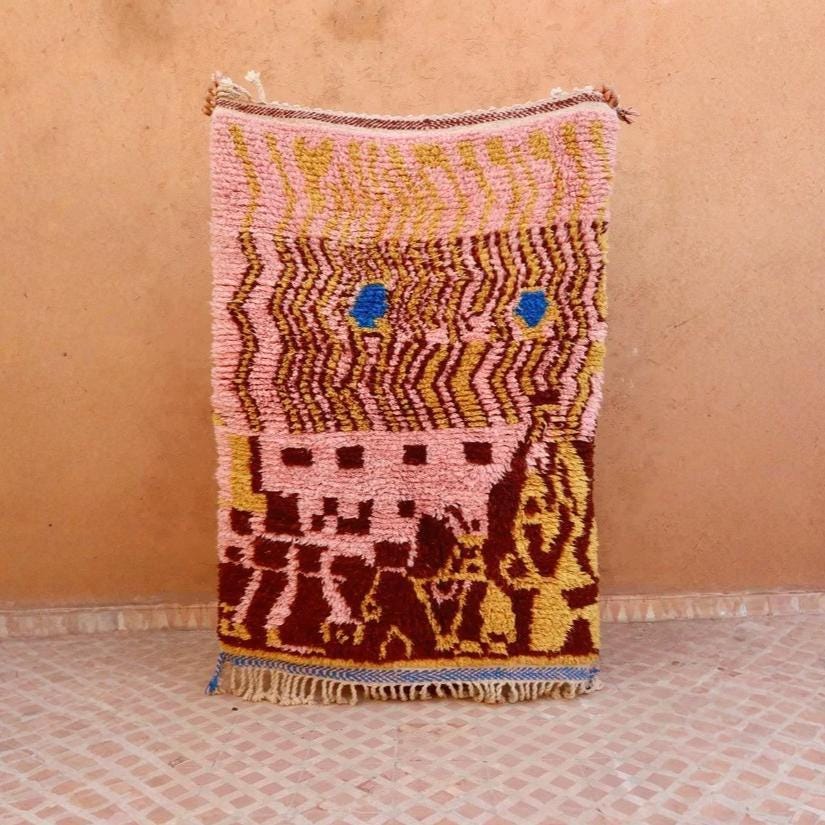
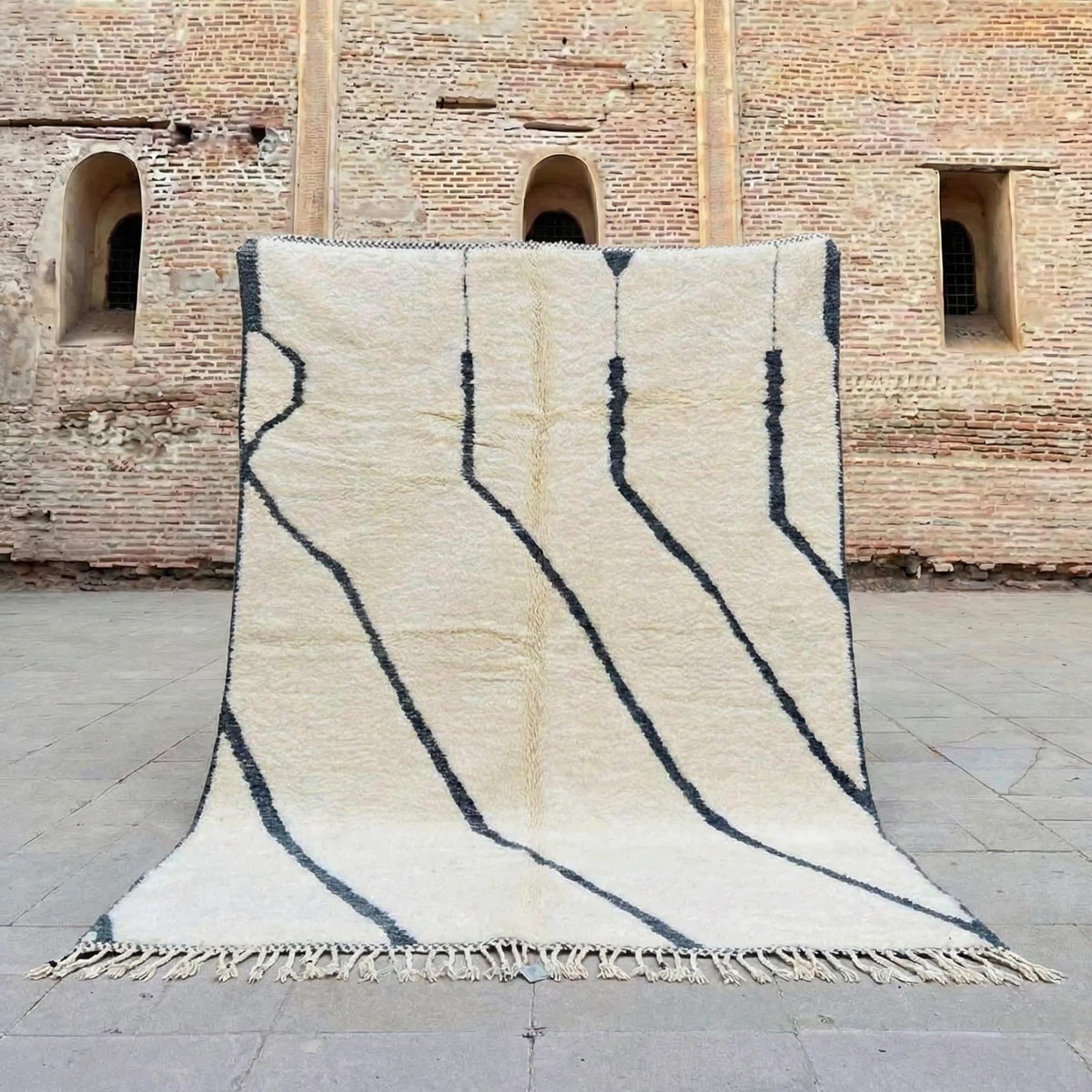
Undyed rugs like Beni Ourain use natural cream, ivory and brown wool. Coloured rugs often show "abrash", gentle shifts in shade where a new batch of wool was used. Flat, perfectly uniform colour across a large rug can be a sign of synthetic fibres and industrial dyes.
6. Feel the weight
A hand-knotted wool rug is heavy. A thick 6x9 ft Beni Ourain can weigh 15 kg or more. If a large "Moroccan" rug feels light and thin, it is unlikely to be hand-knotted wool.
7. Look at the price and the seller
A large handmade rug takes a weaver weeks or months to make. If a big "authentic Berber rug" costs the same as a mass-produced rug, it is almost certainly a copy. Ask the seller where the rug was made, who wove it and what it is made from. A trustworthy seller will answer clearly.
Why buying direct matters
Every rug we sell is hand-knotted from 100% wool by the women of our weaving cooperative in the Atlas Mountains, and shipped directly from Morocco. There are no middlemen, so more of the price goes to the weavers and you get a real rug at a fair price.
Quick checklist
- Pattern visible on the back, with small irregularities
- Fringe is part of the rug, not sewn on
- Natural wool that feels springy, not shiny
- Small, natural imperfections in the design
- Gentle colour variation
- Heavy for its size
- A clear answer about who made it and where
Want to go deeper? Read our complete Moroccan rug buying guide, compare Beni Ourain vs Azilal rugs, or browse our handmade Berber rugs.