Why Are Moroccan Rugs So Expensive? And Are They Worth It?
If you have ever priced a real Moroccan rug, you have probably asked the same question: why does a handmade Berber rug cost so much more than a rug from a big furniture store? The short answer is time, wool and hands. The long answer is below, from the weavers who make them.
1. Every rug is knotted by hand, one knot at a time
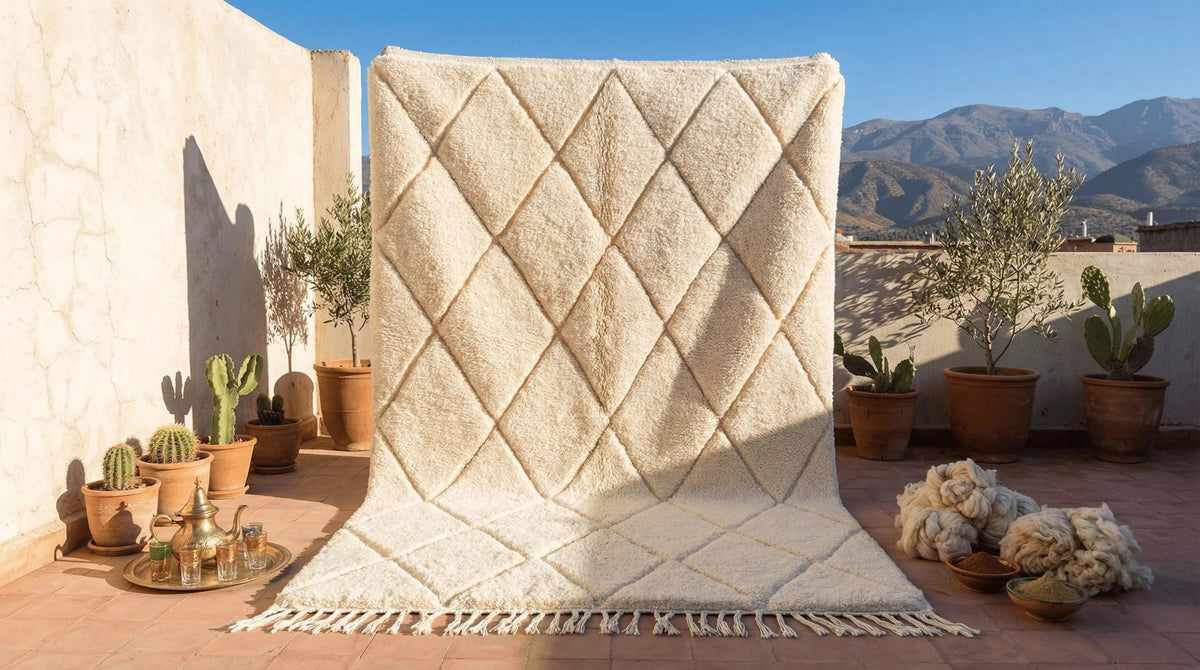
A hand-knotted Moroccan rug is built knot by knot on an upright loom. A medium-size rug can contain hundreds of thousands of individual knots, each tied by hand and cut to length. Depending on the size, pile height and pattern, one weaver can spend several weeks on a single rug, and large rugs are often shared between two or three women working side by side. Machine-made rugs are produced in minutes; a handmade rug is measured in weeks.
2. The wool is real, natural and prepared by hand
Authentic Berber rugs are made from natural sheep's wool from the Atlas Mountains. Before any weaving starts, the wool is washed, carded and spun, and for colourful rugs it is dyed before weaving so the colour runs through every fibre. Good wool is soft, springy, naturally stain-resistant and long-lasting, but it costs much more than the polyester, polypropylene or viscose used in mass-produced "Moroccan style" rugs.
3. No two rugs are the same
Weavers knot their designs freehand, often without a drawing. Lines wander slightly, motifs shift and every rug ends up one of a kind. You are paying for an original piece, not one copy out of thousands. Learn how to tell the difference in our guide to real vs fake Moroccan rugs.
4. Size changes the price a lot
Because the work grows with every square foot, a large rug costs far more than a small one. A doormat-size rug can be very affordable, while a 9x12 or 10x14 living room rug represents weeks of work and a lot more wool. This is also why many Moroccan rug shops show a wide price range on the same design.
5. Shipping heavy wool rugs across the world
A thick wool rug is heavy. Sending it from Morocco to the USA, the UK, Europe or Australia with tracking adds real cost, which many sellers include in the price so you can enjoy free shipping.
6. Middlemen add mark-ups
In many shops, a rug passes through several hands before it reaches you: a collector in the village, a bazaar in Marrakech, an exporter, an importer and finally a showroom. Each step adds a mark-up, and the weaver usually receives the smallest share. Buying direct from a weaving cooperative removes most of these steps, which is why direct sellers can offer authentic rugs at lower prices while paying the weavers more fairly.
Are Moroccan rugs worth it?
For most people, yes. A well-made wool Berber rug:
- lasts for decades, often for generations, instead of a few years
- stays soft and springy underfoot and hides everyday marks better than synthetic rugs
- is naturally warm, quiet and comfortable in living rooms and bedrooms
- adds texture and character that a printed rug cannot copy
Divided by the years you will use it, a handmade rug often costs less per year than replacing cheaper rugs again and again.
How to get a fair price on a real Moroccan rug
- Check what it is made of. Look for 100% wool and hand-knotted construction. Be careful with words like "Moroccan style" or "Berber look".
- Look at the back. On a hand-knotted rug the pattern shows clearly on the back, knot by knot.
- Buy closer to the source. Cooperatives and weaver-owned shops usually cost less than showrooms.
- Choose the right size. Don't pay for more rug than your room needs. Our Moroccan rug size guide will help.
- Ask for a custom size if a standard size doesn't fit. A custom rug woven to your measurements avoids waste.
Frequently asked questions
How much should a Moroccan rug cost?
It depends mainly on size, pile height and design. Small handmade rugs can be very affordable, while large living room rugs cost much more because they take weeks to weave. If a large "Moroccan" rug is extremely cheap, it is very likely machine-made.
Why are some Moroccan rugs so cheap online?
Very cheap rugs are usually machine-made or tufted from synthetic fibres, sometimes printed with Berber patterns. They look similar in photos but feel, wear and age very differently.
Do Moroccan rugs hold their value?
Good handmade wool rugs age well, and vintage Berber rugs are collected all over the world. Even when used every day, a quality rug keeps its beauty for many years.
Shop direct from the weavers: every rug in our Beni Ourain, Azilal and colourful Moroccan rug collections is hand-knotted in 100% wool by Amazigh women in our family's cooperative in the Atlas Mountains, sold with no middlemen and shipped free worldwide, delivered in 5–10 days.


